
ICONE will be in Saclay
The CEA and the CNRS have officially chosen Saclay as the site for the future compact neutron source.
Read more
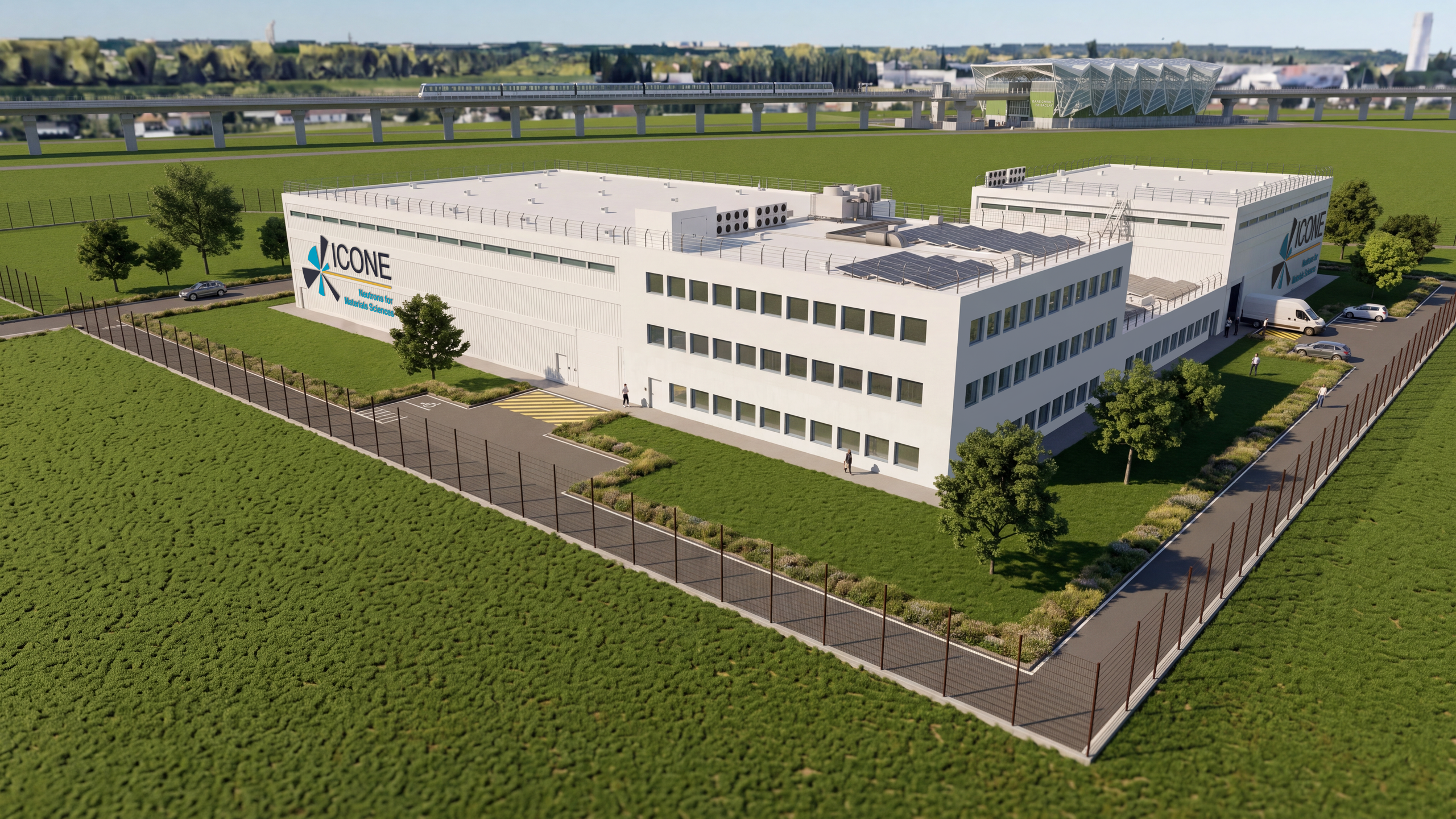
Artistic view of the national infrastructure "ICONE" and the environment designed by Léon Delay (leon.delay.pro@gmail.com)
For several years, the community of neutron experts has been streadily shrinking, even as needs increase. Once very active in France, they are now turning their attention abroad, to other continents. The stop of nuclear reactors and the development of new technologies for neutron scattering place France at disadvantage in this field on a global scale. Icone project began with this issue. The objective is to provide around 10 instruments to researchers, with a quick and easy access. Moreover, Icone aims to be collaborative and wishes to provide two instruments designed exclusively for private companies. Then, they could benefit from the assistance of an expert technician. This collaborative space must respect rules and ensure confidentiality. Private results and data won't be accessible.
Team's expertise in state of the art measuring instruments.
Work with private company to develop collaboration between researchers and industry representatives.
An infrastructure project which place France among the leaders of neutron scattering.
From the preliminary design stage to full operational capacity, follow the progress of the ICONE project.
📝 Preliminary studies and initial design of the neutron source.
Work has begun on the Saclay site. Geotechnic studies have started, marking an important milestone in the realization of our project
⚡ First operational phase with high-flux neutron production.
🔬 Achieving full capacity with unrivalled resolution for cutting-edge research.
Stay up to date with the latest developments and important announcements regarding ICONE.
The CEA and the CNRS have officially chosen Saclay as the site for the future compact neutron source.
Read more
A new recruit has joined the management team to lead this ambitious project.
Read more
The Detailed Preliminary Design (APD) documents are now available for consultation.
Read moreThe unique properties of neutrons make them an excellent non-destructive tool for probing matter. What sets neutrons apart from other methods is their strong interaction with light elements. For example, they make it much easier to detect hydrogen leaks inside metal containers.
Significant penetration power, enabling analyses in volume and under in situ and operando conditions.
Sensitivity to light elements, allowing the highlighting of hydrogen sites.
An isotopic contrast that makes it possible to distinguish between hydrogen and deuterium with precision.
Wavelengths comparable to atomic distances, revealing atomic structures.
Energies suited to the internal excitations and dynamics of matter.
A spin of 1/2 that makes it possible to reveal magnetic structures at the atomic scale.
After the nuclear reactors of the 50s-60s and spallation sources of the 80s-90s, a new generation of sources is appearing: the HiCANS.
ICONE (Installation COmpacte de NEutrons), which is part of it, is a national facility open to users needing to conduct neutron scaterring experiments.
The project is being jointly developed by the CEA and the CNRS.


Find out a bit more about ICONE with the help of our documentation.